

Building Robust IVDs – Fundamentals of regulated product development (Part 1)
Updated: May 11

The Hierarchy of regulatory requirements
In established medical device and IVD markets, regulatory requirements are structured in a clear hierarchy. Laws define the legal obligations manufacturers must meet. These are supported by regulations, which translate the law into more detailed, enforceable requirements. Finally, guidelines and technical standards sit beneath regulations, providing practical guidance on how compliance can be achieved.

Why regulation matters in IVD development
The primary objective of medical device and in vitro diagnostic (IVD) regulation is simple but critical: to protect patients and public health by ensuring unsafe products never reach the market. For IVD manufacturers, understanding and navigating regulatory requirements is not a box-ticking exercise—it is fundamental to successful product development and commercialisation.
While regulatory frameworks vary between countries, there has been a long-standing effort to harmonise global requirements. This began with the Global Harmonisation Task Force (GHTF) in the 1990s and continues today through the International Medical Device Regulators Forum (IMDRF). These initiatives aim to align principles, terminology, and expectations across major markets.
The role of Regulatory Authorities
A Regulatory Authority is the legally empowered body that controls the sale and use of medical devices within a specific jurisdiction. These authorities have the power to:
Prevent non-compliant products from entering the market
Stop the sale or importation of devices
Enforce corrective actions where safety or performance is compromised
For IVD developers, this means regulatory compliance must be designed into the product from the outset—not added as an afterthought.
Risk classification drives regulatory burden

One of the most important regulatory concepts is risk-based classification. The higher the risk or novelty of an IVD, the greater the level of scrutiny applied by regulators. This directly impacts:
The number and scope of performance studies required
The volume of technical documentation
The complexity and duration of regulatory submissions
In practical terms: Higher risk = more evidence = more structured development planning
How Device Scope helps
At Device Scope, we support clients in building regulatory-ready development strategies from day one. By aligning technical, clinical, and regulatory thinking early, we help teams avoid costly rework, reduce time to market, and build confidence with regulators
Quality Management Systems – The Backbone of Compliant IVD Development

What is a Quality Management System (QMS)?
A Quality Management System (QMS) is a formalised framework that defines how an organisation plans, controls, records, and improves its activities to consistently deliver safe and effective products.
For IVD manufacturers, a QMS ensures that:
Activities are planned and proceduralised
Responsibilities and accountabilities are clearly defined
Products meet predefined acceptance criteria
Records provide objective evidence of compliance
Risks are identified, evaluated, and minimised
Beyond good business practice, a QMS is a regulatory requirement in almost every major market.
ISO 13485: the global benchmark
The most widely recognised QMS standard for medical devices and IVDs is ISO 13485:2016. This standard defines a process-based approach to quality management covering:
Design and development
Manufacturing and supply chain
Risk management
Post-market activities
Importantly, ISO 13485 applies across the entire product lifecycle, from concept through to market surveillance. In the early phases of product development Design Controls focus on planning, inputs, outputs, design review, verification, validation, and design transfer, and then in the latter stages Change Control applies to modifications of established specifications, processes, or QMS documents. With Risk Management being used throughout the product lifecycle to identify, assess, control, and review potential risks to quality system processes to prevent product defects and improve performance.
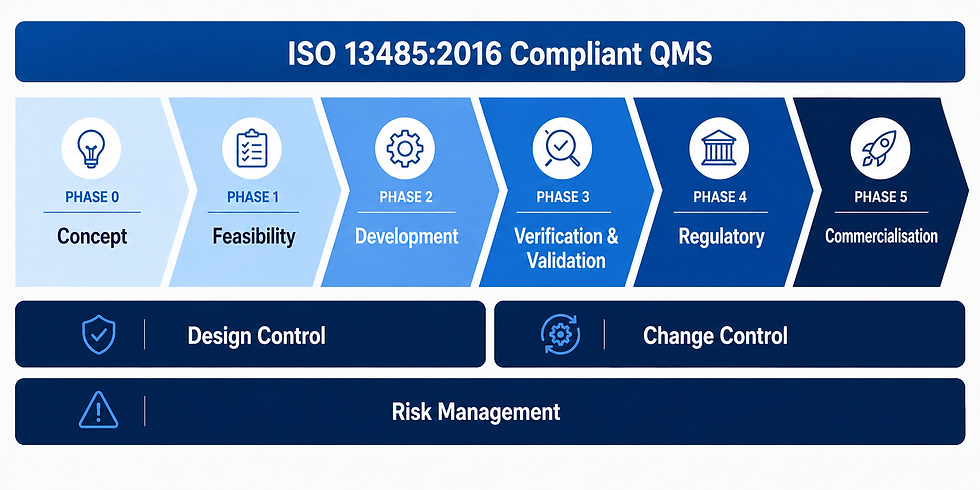
Risk-based thinking is central
ISO 13485 requires manufacturers to adopt a risk-based approach across all processes. This links directly with formal risk management activities and ensures that:
Higher-risk activities receive greater control
Quality efforts are proportionate and effective
Patient safety remains the primary focus
Why QMS maturity matters
Without a documented and implemented QMS:
Regulatory approval is not possible in most regions
Product launches are delayed or blocked
Companies are exposed to audit findings and enforcement action
A well-designed QMS, however, becomes a strategic asset—supporting scalability, efficiency, and investor confidence.
Device Scope works with IVD developers to feed information into their QMS system, and where no QMS exists then help establish practical and right-sized QMS frameworks for regulatory expectations without unnecessary bureaucracy—supporting both innovation and compliance.

This is part 1 of a 2-part series. For part 2, see:


Comments